

As higher education continues to transform globally in the aftermath of the Covid-19 pandemic, leading academic destinations, including those in the United States, the United Kingdom, Australia, and Europe, have faced declining international enrolment and structural pressures that challenge traditional teaching models.
While many institutions grapple with these disruptions, Thailand is steadily positioning itself as a promising regional hub for advanced dentistry education.
At the Faculty of Dentistry at Chulalongkorn University, one of Thailand’s foremost dental institutions, shifts in academic strategy and clinical training have strengthened its competitiveness at a time when Western programmes are undergoing major recalibration.
Dr Nikos Mattheos, an internationally recognised dentist and educator who joined the faculty as a visiting professor, observed that a notable global trend has been the reduction of hands-on clinical exposure in favour of new technologies such as robotics and AI.
“Technology is essential, but clinical competence remains the foundation of dentistry,” Dr Mattheos said.
“Students must learn to operate independently before relying on digital tools. That balance is increasingly difficult to maintain in some Western programmes.”
Chulalongkorn University has taken a different approach, one that integrates emerging technologies without compromising the depth of practice-based training.
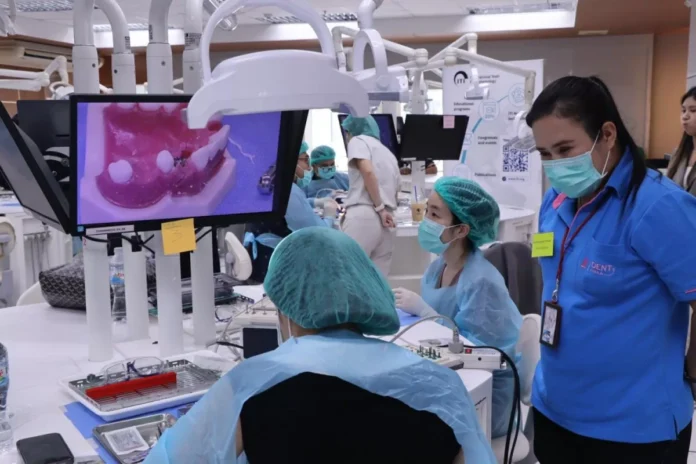
Its curriculum blends robotic-assisted treatment systems, digital dentistry platforms and simulation technologies with extensive clinical rotations, enabling students to develop both advanced technical literacy and strong procedural skills.
This holistic model is supported by Thailand’s diverse dental landscape and robust patient pool, especially in specialised fields such as implantology, periodontics and geriatric dentistry.
With the country’s rapidly ageing population, students have access to real-world clinical cases across a wide spectrum of conditions.
“An ecosystem that offers both technological exposure and rich clinical experience is rare,” Dr Mattheos noted.
“Thailand provides both, which is why its programmes are attracting increasing international interest.”
Under the programmes he collaborates on, clinical training emphasises bone and facial structure navigation, aesthetic procedures and implant surgeries, areas in which patient demand continues to grow globally.
The emphasis on quick, painless and cost-efficient treatment aligns closely with future trends in dental care.
“Technology enables procedures to become faster, safer and more affordable,” he said. “That philosophy is central to the programmes at Chulalongkorn University.”
Over the past five years, the university has invested in strengthening its research capacity and recruiting leading international scholars through initiatives such as the “Top Professor” scheme and the Smart-Talent Visa.
These allow academics to collaborate on high-impact research, develop clinical trials and contribute to specialised postgraduate training.
Such efforts mirror broader regional momentum. East Asia has seen remarkable growth in global rankings, with 23 universities securing a place among the world’s top 100 in 2024 — up 35% since 2015.
Thailand’s expanding English-language dentistry programmes, combined with accessible clinical opportunities and an innovation-driven curriculum, now position the country to compete more directly with established regional education hubs.
“Chulalongkorn University, along with other Thai institutions offering international programmes, has the potential to rival Hong Kong and Singapore,” Dr Mattheos said.
He stressed that overcoming bureaucratic and immigration barriers will be key to sustaining this momentum.