
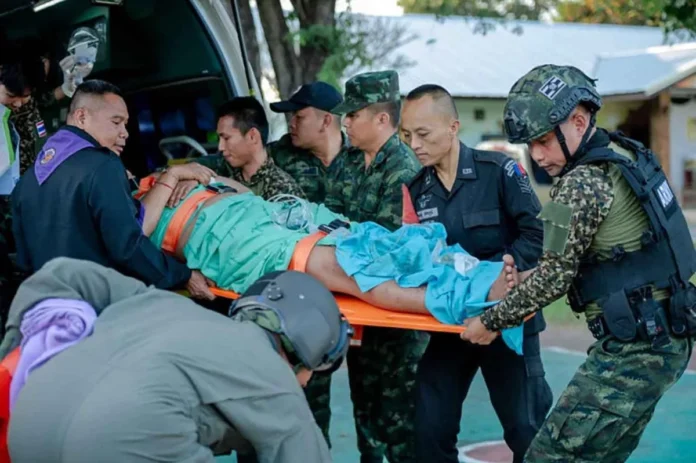

The Ministry of Public Health has deployed emergency medical teams to respond to escalating clashes along the Thai‑Cambodian border, relocating over 500 patients to safer hospitals and providing round‑the‑clock care for more than 147,000 displaced people.
Speaking on Tuesday following a meeting on the situation along the border, Dr Ekachai Piansriwatchara, deputy permanent secretary and spokesman for the Public Health Ministry, reported that 19 hospitals near the border had been affected by the recent fighting in Ubon Ratchathani, Si Sa Ket, Surin, Buri Ram and Sa Kaeo.
Of these facilities, 11 have partially suspended services, while eight have temporarily shut down due to safety risks. The eight hospitals include Nam Yuen, Na Chaluai and Nam Khun Hospitals in Ubon Ratchathani; Kantharalak and Phu Sing hospitals in Si Sa Ket; Kap Choeng and Phanom Dong Rak hospitals in Surin; and Ta Phraya Hospital in Sa Kaeo.
The ministry has already evacuated 534 patients to safer hospitals located farther from the conflict zones.
At the primary-care level, 174 tambon health promotion hospitals in risk areas are also affected, with 167 temporarily closed and seven providing partial services.
Dr Ekachai said that medical authorities have made preparations in case hostilities intensify, including 368 ICU beds and 4,323 general beds available for hospital transfers.
He said there are currently 619 evacuation centres, which are housing over 147,000 evacuees, including over 20,900 vulnerable individuals, such as people with disabilities, the elderly, young children, bedridden patients, dialysis patients, pregnant women and those with chronic psychiatric conditions. Medical teams are stationed at all shelters to provide 24-hour care.
To reinforce the response, multiple specialised units have been deployed along the border. These include 23 mini-medical emergency response teams (Mini Merts), 56 advanced-life-support emergency medical teams, 51 joint investigation teams (Jit) for disease control, 19 Special Environmental Health Response Teams (SEhRT) and 34 mental health crisis response teams (MCATTs).
Mental-health screenings conducted in Ubon Ratchathani, Si Sa Ket and Sa Kaeo assessed 13,058 people, with 23 individuals identified as highly stressed or at risk of self-harm.
All have received immediate psychological first aid and follow-up care.
Dr Ekachai urged residents in high-risk areas to follow official instructions closely and rely solely on government information channels to avoid confusion or panic.
Meanwhile, Public Health Minister Pattana Promphat confirmed that he had ordered directors of hospitals along the border to relocate both patients and medical personnel from high-risk locations to safer facilities.
He added that his ministry is closely monitoring the situation and has prepared a three-tier response plan should the conflict escalate or prolong.
Several hospitals in risk areas have been ordered to temporarily suspend operations, while medical teams have been deployed to staff evacuation centres to provide care for evacuees.
Mr Pattana emphasised that the ministry still has sufficient medical personnel and can continue staffing more facilities without shortages.
As of Tuesday afternoon, no hospital had been damaged by direct attacks, he said.