

Private sector warns of sub-2% expansion as strong baht, export decline and political transition compound longstanding economic vulnerabilities.
Thailand’s economy is projected to record its lowest growth rate in three decades this year, expanding below 2% for the first time outside crisis periods, according to the Joint Standing Committee on Commerce, Industry, and Banking (JSCCIB).
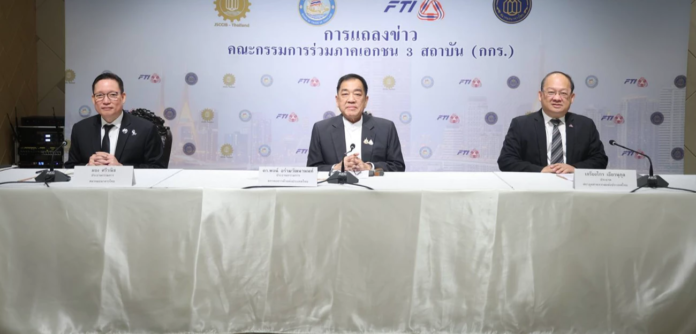
Speaking at the monthly meeting on Wednesday, Dr Poj Aramwattananont, chairman of the Thai Chamber of Commerce and Board of Trade, warned that Thailand faces the slowest growth in the region, hampered by both longstanding structural fragilities and mounting external pressures.
The JSCCIB forecasts GDP growth of 1.6% to 2.0% for 2026, with exports projected to contract between 0.5% and 1.5% – a stark reversal from the estimated 10% export growth in 2025.
Multiple Headwinds Converge
The private sector coalition identified a confluence of challenges weighing on the Thai economy.
Domestically, the country grapples with a substantial informal economy, elevated household debt, limited fiscal capacity, and regulatory complexity that hampers data connectivity across government agencies.
These structural issues are compounded by the lingering effects of last year’s natural disasters, rising cybercrime, grey capital flows, and potential delays in the budgetary process.
Of particular concern is the Thai baht’s 8.2% appreciation over the past year – the second-strongest performance in the region.
Payong Srivanich, chairman of the Thai Bankers’ Association, described this as an effective additional tax on exporters that erodes competitiveness.
He called for enhanced regulatory surveillance to track these capital movements and prevent them from undermining the real economy.
Kriengkrai Thiennukul, chairman of the Federation of Thai Industries, highlighted the competitive disadvantage this creates.
While the baht strengthened, Vietnam’s dong weakened by approximately 3%, generating an 11-13% price gap for comparable goods.
Global Uncertainties Mount
The JSCCIB expressed growing concern over global economic uncertainty stemming from geopolitical factors.
Recent US intervention in Venezuela signals an increasingly polarised “New World Order” that affects the global economic system, expected to expand more slowly than last year.
Dr Poj noted that whilst direct trade between Thailand and Venezuela remains modest at approximately $500 million, the broader implications for supply chains and energy markets – given the $60 billion in regional investments – require close monitoring.
The impact of US tariff measures is also becoming more apparent, with Thai exports excluding electronics already showing contraction, reflecting heightened uncertainty for the Thai economy.